
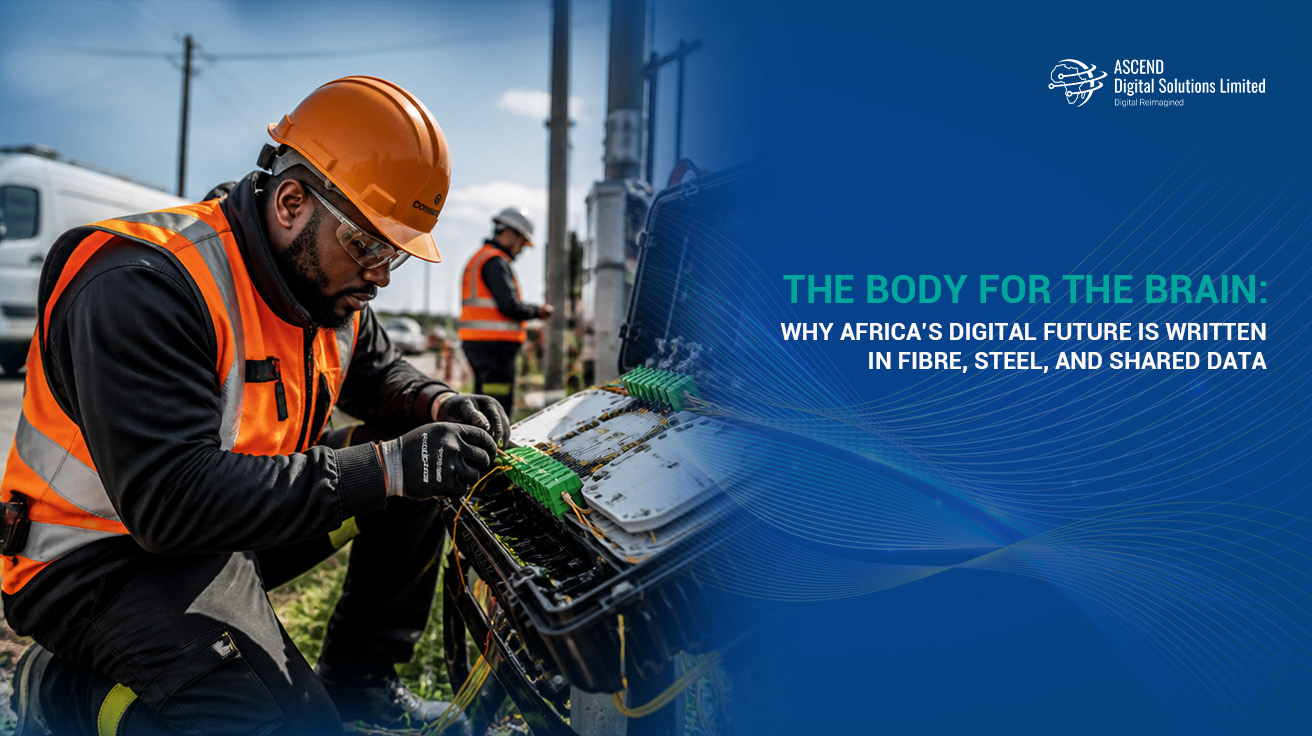
The shift from software to the physical reality of technology brings the true challenge of the digital age into focus.
When discussing the future of digital transformation and Artificial Intelligence across the African continent, the conversation quickly stalls if we only look at front-end applications and chatbots. The reality is that an intelligent digital future cannot exist in a vacuum; it requires a massive, physical, and highly resilient foundation.
At Ascend Digital Solutions, our role is to act as the architect of that foundation. As an international player shaping the digital landscape, our focus is on the macro-infrastructure—the fibre, the steel towers, and the open-access frameworks that connect communities and allow data to move seamlessly across borders.
The Steel and Fiber of Inclusivity
True digital transformation is measured by its reach, not just its speed in capital cities. A primary example of this is our work on the Rural Telephony Programme, a massive undertaking aimed at deploying robust mobile networks to unserved and underserved areas. From the data hubs of Accra all the way to the rural communities of Bawku, we are revitalising digital infrastructure to bridge the urban-rural divide.
By establishing thousands of telephony sites, we are creating a framework where any mobile network operator can plug into our shared infrastructure. This open-access approach dramatically lowers the cost to serve the “Last Mile.”
As we look towards the future, this is exactly where the pipeline for intelligent automation becomes vital. By preparing these remote tower networks for AI-driven predictive analytics, we can move away from reactive maintenance. Instead of waiting for a rural site to lose power or connection, machine learning algorithms will analyse real-time performance data to predict hardware degradation before it impacts a local economy. For a cocoa farmer or a small-scale trader in a remote district, this translates directly to uninterrupted access to the market.
Strengthening the National Core: The E-Transform Vision
Beyond rural connectivity, the core network must be robust enough to carry massive, modern data loads. Through initiatives like the E-Transform programme, we have worked to connect essential public facilities—including hospitals, police stations, and post offices—across the country to a unified digital ecosystem. Supported by a high-capacity 100-gig backbone, this project represents the true scale of heavy-lift infrastructure.
This high-speed backbone is exactly what makes future technological leaps possible. High-tier automated tools, whether used for real-time diagnostic support in healthcare or advanced logistics in public safety, rely on massive data throughput. By constructing a robust, high-bandwidth corridor, we ensure that public institutions aren’t bottlenecked by slow connectivity when trying to deploy modern digital services.
The Infrastructure Rule: A digital ecosystem can only move as fast as its slowest link.
By upgrading the core network to a 100-gig capacity, the artificial limitations on what African developers and public services can build are effectively removed.
The Architecture of a Borderless Continent
If fibre optics and towers are the veins of this digital body, then data is the lifeblood that must flow through them. However, Africa’s greatest digital challenge has always been fragmentation—national systems that function beautifully inside their own borders but become blind the moment a line is crossed on a map. To solve this, we are moving beyond just laying physical infrastructure; we are building the continental data highways.
Our strategic partnership with the India Urban Data Exchange (IUDX) brought a revolutionary open-source, federated data framework to the continent. Rather than building a single, rigid data silo that compromises national sovereignty, this framework allows each country to manage its own secure database instance while enabling them to securely “talk” to each other through standardised protocols.
This technical framework became a reality on the continental stage through our landmark agreement with the Smart Africa Alliance to deploy and operate the Smart Africa Data Exchange (SADX) platform. Operating under the Smart Africa Trust Alliance (SATA) framework, this digital public infrastructure is a direct step towards a unified African Single Digital Market.
With Ghana and Benin having recently validated their technical readiness, we are piloting a proof-of-concept across Ghana, Benin, and Rwanda. The immediate mission? Enabling the mutual recognition of national Digital IDs and cross-border SIM card registrations. This means a traveller from Accra can securely verify their identity to access healthcare, banking, or e-commerce while in Kigali or Cotonou without friction.
By scaling this federated architecture across Smart Africa’s 42 member states, we aren’t just facilitating data exchange. We are opening up secure, transactional APIs that will eventually allow banks, telcos, and fintechs to scale regionally, unlocking an African digital economy projected to cross hundreds of billions of dollars.
Guarding African Digital Sovereignty
As data demands grow exponentially, the question of data sovereignty becomes a critical priority. True digital independence means ensuring that the traffic generated on the continent stays on the continent. By building, managing, and commercialising large-scale terrestrial fibre routes and foundational networks, Ascend ensures that regional data travels over secure, locally managed pathways.
This keeps critical data protected under regional regulations and within domestic borders, reducing reliance on international routing that drives up costs and introduces unnecessary latency. We are securing the digital borders of the continent, ensuring that our growing digital economy is built on a foundation we control.
The Body for the Brain
The excitement surrounding the digital future is justified, but a brain cannot function without a body to sustain it. Ascend Digital Solutions is that body. We are the fibre under the soil, the steel towers on the hills, the high-capacity backbones connecting cities, and the secure data exchanges bridging borders.
We continue to pour the concrete, string the fibre, and link the data pathways because we know a fundamental truth: the most brilliant innovations are just a dream without the physical and foundational infrastructure to make them real.